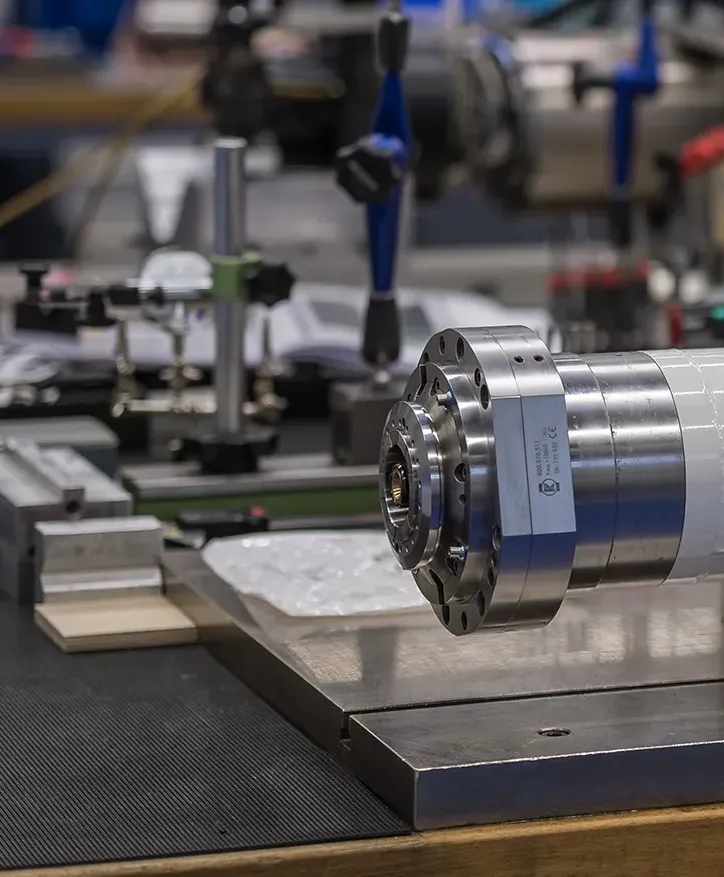
Swiss precision technology for high-end manufacturing
The Fischer Spindle Group, headquartered in Herzogenbuchsee, has been defining the limits of what is technically feasible in machining for decades. Where standard components in machine tools reach their physical limits, Swiss spindle systems come into play. The company, whose roots date back to 1939, focuses specifically on industries with zero-defect tolerance. These include the aerospace industry, demanding tool and mold making, and the automotive sector.
In these sectors, the spindle is a complex mechatronic system that determines the quality of expensive titanium structural components or high-precision watch components. Fischer addresses precisely these requirements with a clear focus on "perfect rotation" – the control of rotation under extreme conditions.
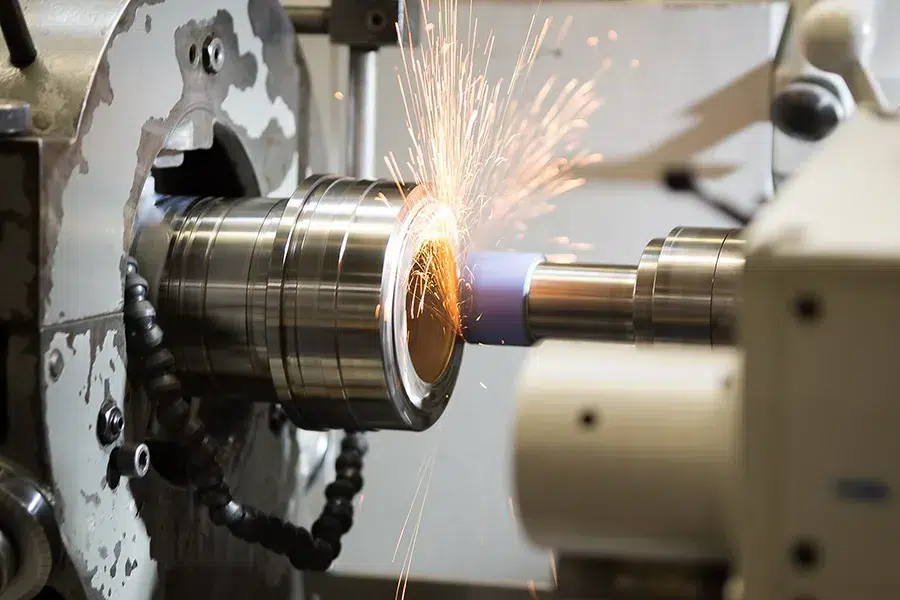
From heavy-duty machining to ultra-high speed
Fischer's product range is characterized by an enormous technological spectrum, which has been consolidated by strategic acquisitions such as the US brand PRECISE. The portfolio thus covers two extreme requirements of modern manufacturing: maximum force and maximum speed.
In the field of milling spindles, the MFW series sets the technological standard for machining centers. These spindle units use powerful synchronous motors to achieve high torque density in a compact installation space. They are ideal for machining high-strength materials, such as those commonly used in aircraft construction.
At the other end of the spectrum are solutions for grinding and micro-machining. By integrating PRECISE technology, Fischer offers spindles that can reach speeds of up to 180,000 rpm. These high-frequency spindles are in demand in medical technology, the optical industry, and watch manufacturing, where the smallest geometries and mirror-smooth surfaces are required.
Thermal stability and intelligent sensor technology
Fischer's decisive competitive advantage lies in its consistent solution to thermodynamic problems. In high-speed machining, heat is the greatest enemy of precision. Conventional spindles often only cool the stator housing, which causes the rotating part (the shaft) to heat up and expand axially. This leads to dimensional deviations in the Z-axis.
Fischer addresses this phenomenon with its patented Cool-Core technology (CSC). This system guides the cooling medium through the rotating shaft. The result is a thermally neutral spindle. Even during hours of finishing operations at maximum speed, linear expansion remains minimal, eliminating the need for recalibration and greatly increasing process stability in mold making.
In addition, Fischer is pushing ahead with the digitization of hardware ("Smart Spindle Technology"). Integrated sensors measure axial shaft displacement and vibrations in real time. Acceleration sensors continuously monitor the condition of bearings and imbalances. This enables true "predictive maintenance": the machine reports wear before a crash occurs.
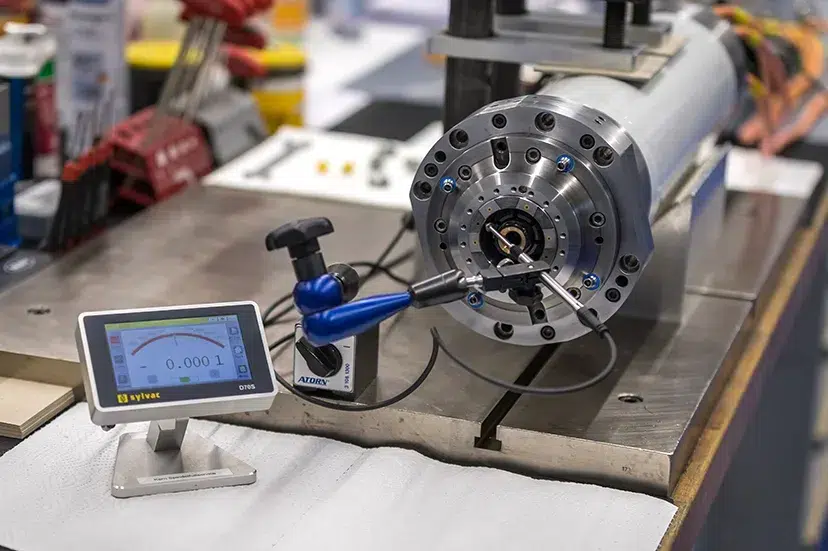
Kern GmbH – Your partner for services related to your Fischer spindle
The repair of such high-end systems—especially those featuring technologies such as wave cooling and integrated sensor technology—does not tolerate improvisation. Over 14,000 spindle repairs on more than 2,800 different spindle types form the basis of the expertise that Kern GmbH offers you as your service partner. A Fischer spindle is a precision instrument, and that is exactly how we treat it in our repair workshop.
Our primary goal is to drastically reduce your production downtime. We understand the complex architecture of Fischer systems, from the correct adjustment of sensors to leak testing of internal cooling circuits. Thanks to our optimized internal processes, we are often able to get your system back up and running faster than would be possible using standard methods. Do you have questions about the maintenance, optimization, or repair of your Fischer spindle? Please contact our technical customer service directly.