
Moore Tool Grinding Spindles – The Gold Standard in Coordinate Grinding Technology
Moore Tool – A Pioneer in Coordinate Grinding Technology
Anyone familiar with Moore Tool usually associates the name with a machine that set new standards in 1940: the jig grinder. What is now considered an established process in tool and mold making, aerospace, and optical manufacturing was a technological breakthrough at the time. For the first time, holes could be ground with precise positioning directly in the hardened state.
The company's origins date back to 1924. Richard F. Moore started out with a small workshop in Bridgeport, Connecticut. Over the decades, these humble beginnings grew into one of the leading precision machine tool manufacturers in the United States. Moore manufactured thousands of jig boring and jig grinding machines and supplied customers in the aerospace, optical, and defense industries, among others. Moore Tool has been part of the PMT Group since 1994 and works closely with Moore Nanotechnology Systems.

Grinding spindles with a unique design
Moore grinding spindles are not conventional motor spindles. The company manufactures two fundamentally different types of spindles: air turbine spindles and electric grinding spindles. Both are specifically designed to meet the extreme demands of coordinate grinding.
Air turbine spindles achieve speeds ranging from 9,000 to 175,000 rpm. Models with speeds of 40,000 rpm or higher are electronically balanced to minimize vibration and ensure a long service life. The 175,000 rpm version is designed for grinding the smallest bores with a shank diameter of 3 mm.
Electric grinding spindles cover speeds ranging from 7,000 to 80,000 rpm and enable precise control. The model with automatic tool change uses HSK-E25 tool holders and offers superior radial runout.
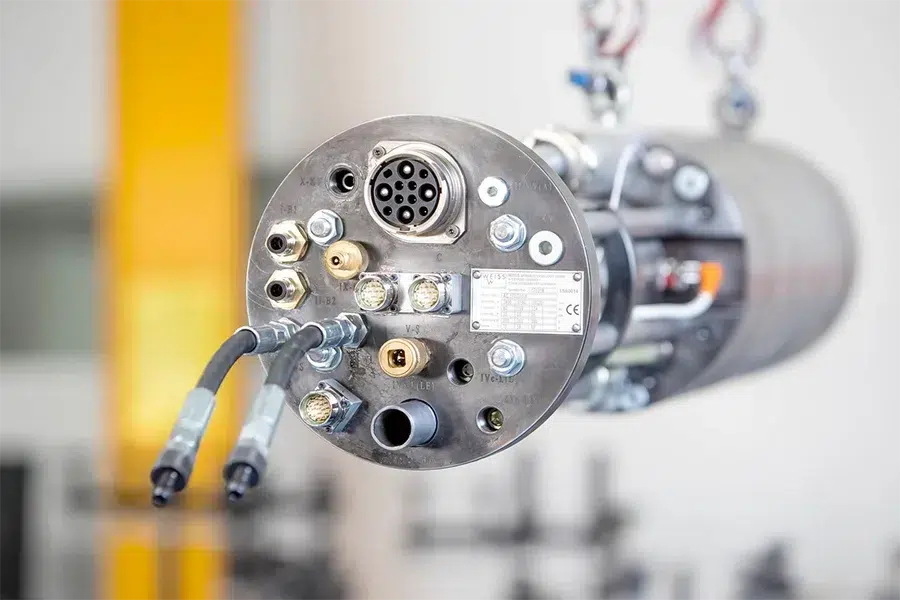
Design and Technical Features
Internally, Moore grinding spindles differ significantly from the motor spindles found in conventional machining centers. Air turbine spindles operate without an electric motor and are driven by compressed air. This allows for extremely high rotational speeds in a compact design.
Electric grinding spindles consist of a spindle motor, a rotor and a stator, precision bearings, and a collet or tool interface.
A key feature is the use of proprietary OEM parts and proprietary assembly techniques. Ceramic hybrid bearings are available for many models, which increase service life and performance. This level of vertical integration enables Moore to restore spindles to their original condition.
Precision work under extreme conditions
Coordinate grinding machines are used in applications where the highest precision is required. The grinding spindle bears the full burden of the process’s precision requirements. Imbalances, bearing play, or thermal effects have a direct impact on the grinding result.
Common causes of failure include bearing wear, contaminants in the compressed air supply for air-turbine spindles, and mechanical damage to the collet or tool interface. Changes in surface quality or concentricity should therefore be checked at an early stage.

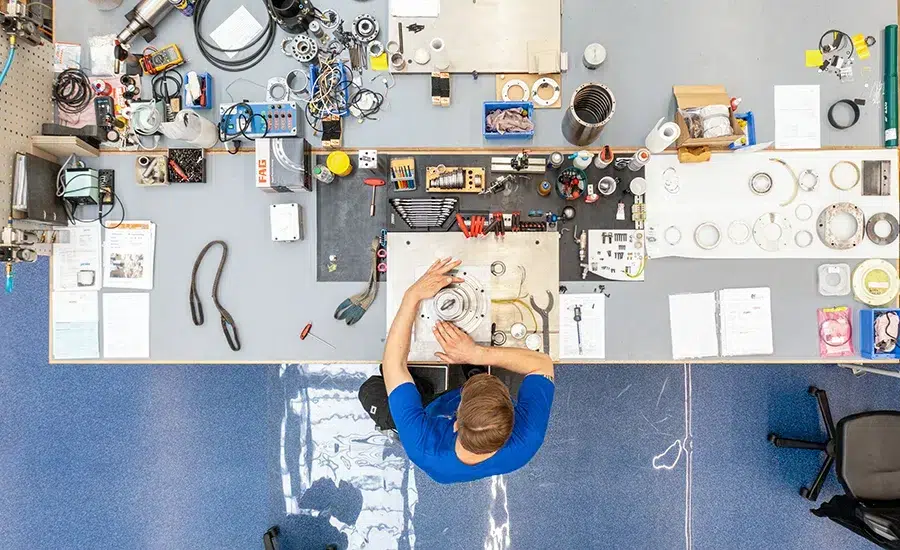
Repair of Moore Tool grinding spindles by KERN
KERN Spindle Service professionally repairs grinding spindles from Moore Tool coordinate grinding machines, including both air-turbine spindles and electric grinding spindles. Our services include precise bearing diagnosis followed by bearing replacement, inspection of the collet and tool interface, balancing in accordance with DIN ISO 1940, and a final test run under realistic conditions.
Experience has shown that a repair by KERN is 20 to 30% more cost-effective than purchasing a new spindle. The average turnaround time is 6 to 8 business days. We provide a 24-month warranty on every repair.
Do you need assistance with your Moore grinding spindle?